A well-maintained lawn can make a home feel more inviting, improve curb appeal, and provide a comfortable outdoor space for relaxing with family. However, keeping grass healthy throughout the year takes more than occasional mowing. Watering, fertilization, weed control, soil conditions, and seasonal maintenance all influence how a lawn looks and grows.
For homeowners in Woodstock, Georgia, deciding how to manage these tasks often comes down to two options: taking care of the lawn themselves or hiring a professional lawn care company. Both approaches have advantages, and the right choice depends on your budget, available time, lawn condition, and expectations.
Doing your own lawn maintenance may be a practical solution if you enjoy outdoor projects and have a relatively healthy yard. On the other hand, professional lawn care services can make maintenance easier when your property has persistent weeds, thinning grass, drainage concerns, or more demanding treatment needs.
So, is hiring a lawn care company better than doing everything yourself? Let’s compare the costs, benefits, responsibilities, and potential drawbacks of each option to help you make an informed decision for your Woodstock home.
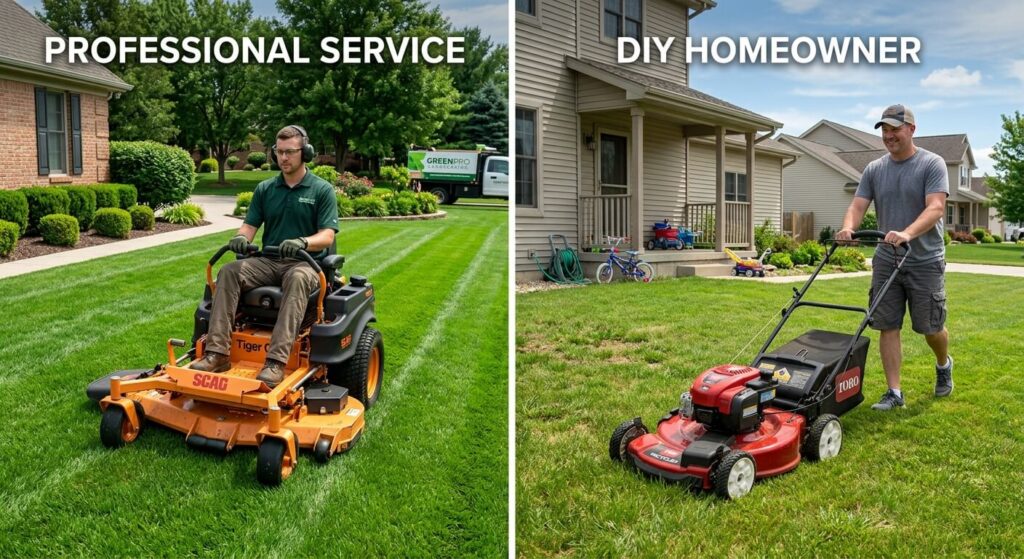
Understanding the Difference Between Professional Lawn Care and DIY Maintenance
Before comparing the two options, it helps to understand what each approach typically involves.
What Does DIY Lawn Care Include?
DIY lawn care means handling routine yard maintenance without paying a professional company to do the work. Depending on your lawn’s condition, this could include mowing, trimming, edging, watering, applying fertilizer, pulling weeds, and repairing small bare patches.
Some homeowners also purchase equipment for more advanced projects, such as core aeration, overseeding, or applying lawn treatments. These tasks may require additional research, specialized tools, and careful attention to product instructions.
The biggest advantage of DIY lawn maintenance is control. You decide when to mow, which products to use, how much to spend, and which areas need attention first. You can also spread projects across several weekends instead of paying for a complete service package.
However, taking care of your own lawn requires consistency. Skipping important maintenance during the growing season or applying the wrong treatment can lead to problems that take time and money to correct.
What Does a Professional Lawn Care Company Do?
A professional lawn care company provides maintenance or treatment services based on your property’s needs. The exact services vary by provider, but many companies offer mowing, edging, fertilization, weed control, aeration, overseeding, and seasonal lawn treatments.
Some providers focus primarily on routine lawn mowing, while others specialize in improving turf health through scheduled treatments and problem diagnosis. Landscaping, shrub maintenance, irrigation services, and drainage work may be available separately.
A professional service can be particularly helpful when you are unsure why your grass is thinning, weeds keep returning, or previous lawn treatments have produced disappointing results.
Rather than purchasing equipment and researching every task yourself, you pay for the company’s labor, experience, and service plan. The trade-off is that professional maintenance adds a recurring expense and requires you to choose a provider that understands your lawn.
Lawn Care Company vs. DIY: A Side-by-Side Comparison
The best option becomes easier to identify when you compare the factors that matter most to homeowners.
| Factor | DIY Lawn Care | Professional Lawn Care |
|---|---|---|
| Upfront cost | Equipment and supplies may require an initial investment | Usually lower upfront equipment costs |
| Ongoing expenses | Fuel, maintenance, fertilizer, treatments, and repairs | Service fees and any additional treatments |
| Time commitment | You handle scheduling and physical work | The company handles the agreed-upon tasks |
| Equipment | You purchase, borrow, or rent equipment | The provider generally brings its own equipment |
| Expertise | Requires research and experience | Offers professional knowledge, depending on the provider |
| Flexibility | Complete control over your schedule | Depends on the company’s service schedule |
| Problem diagnosis | You investigate lawn issues yourself | A qualified provider may help identify likely causes |
| Best suited for | Homeowners who enjoy yard work and have time | Busy homeowners or those with demanding lawn problems |
Neither option is automatically better in every situation. A small lawn that needs occasional mowing is very different from a large property with compacted soil, recurring weeds, and extensive treatment requirements.
The important question is which approach gives you the best balance of cost, effort, and results for your particular yard.
The Advantages of Doing Your Own Lawn Care
For homeowners who enjoy working outdoors, DIY lawn maintenance can be rewarding. It allows you to develop practical skills, understand your property’s growing conditions, and make decisions without relying on a service provider.
1. You Have More Control Over Your Budget
One of the main reasons homeowners choose DIY lawn care is the opportunity to control spending.
If you already own a lawn mower, string trimmer, and basic yard tools, maintaining a healthy lawn may require little more than fuel, replacement parts, fertilizer when needed, and occasional supplies. You can also prioritize essential work instead of paying for a package that includes services you may not need.
For example, a homeowner with a relatively healthy lawn might handle weekly mowing and edging while purchasing fertilizer only when it is appropriate for the grass type and season.
However, DIY maintenance is not necessarily cheaper in every case. Equipment purchases, repairs, storage, fuel, protective gear, and specialized tools can add up. Renting equipment for occasional projects may be more economical than buying it outright.
It is also worth assigning a value to your time. Spending several hours each weekend maintaining your yard has a cost, even if no money changes hands.
2. You Can Work on Your Own Schedule
DIY maintenance gives you flexibility over when yard work gets done. You can mow before the weekend, remove weeds after work, or spread larger projects over several days.
This can be helpful when your lawn has a simple maintenance routine and you prefer to work around your personal schedule.
The disadvantage is that weather, grass growth, and seasonal timing may not always cooperate with your plans. When work becomes busy or family responsibilities take priority, lawn maintenance can easily fall behind.
3. You Can Learn What Your Lawn Needs
Taking care of your own yard provides an opportunity to understand its particular characteristics.
Over time, you may notice that certain areas receive too much shade, water collects near a walkway after heavy rain, or grass grows poorly beneath mature trees. These observations can help you make better decisions about watering, mowing, and future landscaping projects.
You can also monitor changes after making adjustments, which helps you understand what works and what does not.
Still, visible symptoms do not always reveal the underlying problem. Yellowing grass, for instance, can result from nutrient deficiencies, excess water, drought stress, disease, or other conditions. Learning to distinguish these issues is important before spending money on treatments.
4. You Can Choose Your Own Products and Methods
DIY lawn care allows you to select the products and maintenance methods you prefer.
Some homeowners want to minimize pesticide use, focus on improving soil conditions, or adopt more environmentally conscious watering practices. Managing the work yourself makes it easier to choose an approach that reflects those priorities.
That freedom comes with responsibility. Fertilizers and weed control products must be appropriate for the grass type, application area, and intended use. Always follow the product label, including application rates and precautions.
If you are uncertain about a treatment, consult reliable local guidance before applying it.
The Disadvantages of DIY Lawn Maintenance
Although handling lawn care yourself can save money in some circumstances, it also introduces challenges that are easy to overlook.
1. Lawn Care Takes More Time Than Expected
Mowing is only one part of maintaining a yard. Trimming edges, clearing clippings, monitoring weeds, adjusting irrigation, cleaning equipment, and addressing seasonal issues all take time.
Larger properties require even more effort. A yard with steep sections, narrow spaces, mature trees, or numerous landscape beds can take considerably longer to maintain than a simple, open lawn.
There is also the time spent researching products, comparing equipment, and figuring out why a treatment did not work.
If you have a demanding work schedule or prefer spending weekends on other activities, these responsibilities can make DIY maintenance less attractive.
2. Mistakes Can Damage Your Lawn
A common misconception is that more fertilizer, more water, or more aggressive weed treatment will produce faster results.
In reality, applying too much fertilizer can damage turf, excessive watering can encourage certain lawn problems, and an unsuitable herbicide can injure desirable grass. Cutting the lawn too short can also weaken it, particularly during stressful weather.
Georgia homeowners need to consider their specific turfgrass variety and local growing conditions. Bermudagrass, zoysiagrass, centipedegrass, St. Augustinegrass, and tall fescue do not all follow the same maintenance schedule.
The University of Georgia Cooperative Extension publishes lawn calendars with recommendations tailored to different grass types. These are useful references for homeowners who want to manage their yards independently.
3. Specialized Equipment Can Be Expensive
Routine mowing requires relatively basic equipment, but certain lawn improvement projects call for more specialized tools.
Core aeration, for example, may require equipment that is costly to purchase and inconvenient to store. Large properties may also benefit from higher-capacity mowers, while complex irrigation systems can require professional assessment or repair.
Buying equipment for a task you perform once or twice a year may not make financial sense.
Before purchasing anything, compare the cost of ownership with rental prices and professional service fees.
4. Persistent Lawn Problems Can Be Difficult to Diagnose
When weeds repeatedly return or bare patches continue spreading, treating the visible symptoms may not solve the underlying issue.
Compacted soil, poor drainage, unsuitable grass varieties, excessive shade, pest activity, and improper watering can all contribute to unhealthy turf.
For example, repeatedly applying weed killer will not correct a drainage problem that leaves the soil consistently saturated. Similarly, adding fertilizer may not help grass that is poorly suited to a heavily shaded area.
DIY maintenance works best when you can identify the problem accurately and choose an appropriate solution. If you have tried several approaches without improvement, professional guidance may save you from spending more money on ineffective treatments.
The Benefits of Hiring a Professional Lawn Care Company
A lawn care company can be a practical investment when you need consistent maintenance, specialized treatments, or help improving a lawn that has become difficult to manage.
1. You Save Time and Physical Effort
Hiring a lawn care service removes some or all of the work from your weekly schedule, depending on the services included.
Instead of spending your free time mowing, trimming, and maintaining equipment, you can focus on work, family responsibilities, hobbies, or other home improvement projects.
This is particularly useful during periods of rapid grass growth when mowing may need to happen frequently.
Before hiring a company, clarify exactly what its regular visits include. Mowing alone may not cover edging, blowing clippings from hard surfaces, weed control, or other tasks you expect.
2. You Gain Access to Professional Experience
Experienced lawn care specialists may recognize common turf problems more quickly than someone learning through trial and error.
They can assess the condition of your grass, review maintenance practices, and recommend suitable next steps. Depending on their qualifications and services, they may also identify when a soil test, irrigation inspection, or more specialized evaluation is needed.
This can be valuable if you are dealing with persistent weeds, thinning turf, uneven growth, or recurring damage.
Keep in mind that not every company offers the same level of expertise. Ask how the provider evaluates lawn conditions, what training its technicians have, and whether recommendations are based on your specific property rather than a one-size-fits-all treatment plan.
3. Your Lawn Can Receive More Consistent Maintenance
Grass responds to regular care, and missed maintenance can become noticeable during active growing periods.
A scheduled lawn care service helps establish a predictable routine. Depending on your agreement, the provider may handle recurring mowing, seasonal treatments, fertilization, or other tasks at appropriate intervals.
Consistency is especially useful for homeowners who travel frequently or struggle to fit yard work into their schedules.
However, a recurring contract does not guarantee a perfect lawn. Results still depend on weather, soil conditions, grass variety, irrigation, shade, and the quality of the work.
4. You May Avoid Unnecessary Purchases
Hiring a lawn care company means you generally do not need to buy every tool required for the services you outsource.
The company usually supplies its own equipment, and the cost of ordinary equipment upkeep is generally part of its operating expenses rather than a separate purchase you must manage.
This can be advantageous if you have limited storage space or do not want to maintain a mower, spreader, aerator, and other equipment.
Compare this benefit with the frequency of service you need. Paying for professional mowing every week may be less economical than maintaining a small lawn yourself if you already have suitable equipment and enjoy doing the work.
5. You Can Get Help With More Difficult Lawn Projects
Some lawn problems require more than regular mowing.
A professional provider may offer core aeration, overseeding, turf repair, fertilization programs, or targeted weed management. These services can be useful when the lawn needs additional attention beyond routine upkeep.
Before scheduling a treatment, ask the company to explain the problem it is intended to address, the expected results, and any limitations.
For example, overseeding will not automatically solve a lawn that struggles because the grass receives too little sunlight. Aeration may help address soil compaction, but it will not correct every drainage issue.
Good lawn care begins with understanding the cause of the problem rather than simply purchasing another service.
The Disadvantages of Hiring a Lawn Care Service
Professional maintenance has clear benefits, but homeowners should also consider the potential downsides before committing to a provider.
1. Professional Services Create an Ongoing Expense
Regular service fees can become a significant part of your household budget, particularly if you purchase several treatments throughout the year.
The total cost depends on property size, grass condition, service frequency, accessibility, and the type of work required. A basic mowing service is generally different in price from a program that includes fertilization, weed control, aeration, and lawn restoration.
Ask for a written estimate that separates routine maintenance from optional treatments. This makes it easier to compare companies and avoid paying for services you do not need.
2. You Have Less Direct Control Over Scheduling
A professional company typically works according to its route, appointment availability, and weather conditions.
Rain, equipment problems, or unusually busy periods can affect scheduling. If you prefer to decide exactly when every task is performed, you may find this arrangement restrictive.
Before signing an agreement, ask how the provider handles weather delays, missed visits, rescheduling, and communication.
3. Service Quality Can Vary
Hiring a company does not automatically mean you will receive excellent lawn care.
Some providers may focus on completing visits quickly rather than addressing individual property needs. Others may offer broad treatment packages that are not suitable for every lawn.
Look for a company that communicates clearly, explains its recommendations, and is willing to discuss your concerns.
Ask for references or recent customer reviews, and pay attention to comments about reliability, communication, and how the provider handles problems after a service has been completed.
4. Some Services May Require Separate Specialists
Not every lawn care company provides every service.
A company that specializes in mowing may not handle irrigation repairs, major grading work, tree removal, or advanced pest and disease diagnosis. You may need to hire another professional for those projects.
Confirm the provider’s service scope before making a decision. It is better to understand what is included at the beginning than to discover later that the work you need requires an additional contractor.
How Much Does DIY Lawn Care Cost Compared With Professional Services?
Cost is often the deciding factor when homeowners compare a lawn care company with DIY maintenance. The most useful comparison includes more than the price of a single service visit.
DIY Lawn Care Expenses
Your DIY budget may include:
- Lawn mower purchase or maintenance
- Fuel, batteries, and replacement parts
- String trimmer and edging supplies
- Fertilizer and soil amendments
- Weed control products
- Water and irrigation expenses
- Protective equipment and storage
- Rental fees for specialized tools
Some of these costs are occasional, while others recur throughout the year. If you already own the necessary equipment, your additional spending may be relatively modest. If you are starting from scratch, the initial investment can be much higher.
Professional Lawn Care Expenses
A professional lawn care budget may include:
- Regular mowing and edging
- Fertilization and weed control
- Seasonal maintenance visits
- Aeration and overseeding
- Lawn disease or pest treatments, when offered
- Additional work for damaged or neglected areas
Not every homeowner needs every service. The goal is to identify the tasks your yard actually requires and compare the cost of outsourcing those tasks with the cost of completing them yourself.
A Simple Way to Compare the Two Options
Use the following formula to estimate the annual cost of each approach.
DIY annual cost:
Equipment expenses allocated to the year + supplies + fuel or electricity + equipment repairs + rental fees + additional water costs.
Professional annual cost:
Total routine service fees + planned treatments + any additional work not included in the regular agreement.
You can also calculate the approximate value of your time by multiplying the number of hours you spend on lawn maintenance by the hourly value you assign to that time.
For instance, suppose you spend three hours a week on lawn maintenance during a 30-week period. That equals 90 hours of work over the season. If outsourcing those tasks frees up time you value highly, a professional service may be worthwhile even if the direct monetary cost is higher.
On the other hand, if you enjoy yard work and already own the equipment, the savings from DIY maintenance may outweigh the convenience of hiring a company.
For an accurate comparison, request estimates from local providers and use your own equipment costs and expected maintenance schedule rather than relying on a generic national average.
Which Option Makes More Sense for Homeowners in Woodstock, GA?
Lawn care decisions should reflect local growing conditions rather than relying on advice intended for a different climate.
Woodstock homeowners experience seasonal changes in temperature and rainfall, and properties can differ significantly in sunlight, soil conditions, slope, and drainage. These differences affect which grass types perform well and how much maintenance a yard requires.
Consider Your Grass Type
Georgia lawns may contain warm-season grasses such as bermudagrass, zoysiagrass, centipedegrass, and St. Augustinegrass. Tall fescue is another common option in suitable areas, including some locations where homeowners prefer a cool-season lawn.
These grasses have different growth patterns and maintenance requirements. For example, warm-season grasses generally grow most actively during warmer months, while tall fescue performs best during cooler periods and can experience stress in summer heat.
If you are unsure what type of grass you have, identify it before purchasing fertilizer or weed control products. A treatment suitable for one grass variety may damage another.
The University of Georgia Cooperative Extension provides lawn care calendars and turfgrass guidance that homeowners can use to plan seasonal maintenance.
Evaluate Shade and Tree Coverage
Some Woodstock properties have mature trees, wooded borders, or shaded areas where grass struggles to grow.
If your lawn is mostly sunny and already healthy, routine DIY maintenance may be sufficient. If substantial areas receive limited sunlight, you may need help determining whether a more shade-tolerant grass, revised landscape design, or alternative ground cover would be more practical.
A professional assessment can help you avoid repeatedly spending money on grass that is unlikely to thrive in the available conditions.
Pay Attention to Slopes and Drainage
Sloped yards and areas that collect water can make lawn maintenance more complicated.
Uneven terrain may require additional care when mowing, while persistent standing water or runoff may indicate a drainage or grading problem. These conditions can also affect grass growth and the effectiveness of lawn treatments.
You can handle simple observations and routine maintenance yourself, but significant drainage problems may require a qualified drainage or landscaping specialist rather than a standard mowing service.
Think About Your Schedule During the Growing Season
Grass growth can accelerate during favorable weather, making regular mowing and timely maintenance especially important.
If you travel often, work long hours, or have little time for outdoor projects, a scheduled lawn care service may help keep your property maintained.
If your schedule is flexible and you enjoy working in the yard, managing the routine tasks yourself may be perfectly reasonable.
The best approach is the one you can maintain consistently without stretching your budget or sacrificing other priorities.
How to Choose a Good Lawn Care Company in Woodstock, GA
If you decide that professional help is the better option, take time to evaluate your choices. A reliable lawn care specialist should understand your goals, explain the work clearly, and provide a service plan that fits your property.
1. Check Reviews and Local References
Start by researching lawn care companies that serve Woodstock and nearby communities.
Read recent customer reviews on Google and other reputable platforms. Look for patterns rather than focusing on one unusually positive or negative comment.
Reviews that mention punctuality, consistent mowing, clear communication, and responsible treatment practices can help you identify promising providers.
You can also ask neighbors or friends who have similar properties whether they would recommend their current lawn care specialist.
2. Confirm the Services Offered
Before requesting an estimate, list the work you need.
Do you want someone to mow and edge the lawn regularly? Are you trying to control persistent weeds? Does your property need aeration, overseeding, or help identifying a recurring lawn problem?
Choose a company whose services match those requirements.
If you need pesticide or herbicide applications, ask about the provider’s applicable Georgia licensing and credentials. Verify requirements with the relevant state agency, particularly for regulated pesticide applications. Do not assume that every employee or general mowing service is qualified to perform every type of treatment.
3. Request a Detailed Written Estimate
A useful estimate should explain what the company will do, how often it will visit, and what the quoted price includes.
Ask whether edging, blowing clippings off paved areas, collecting debris, and other tasks are included in the mowing fee. For treatment programs, request details about the products or treatment categories, application schedule, and any additional charges.
Compare at least two or three suitable providers when practical.
The lowest estimate is not necessarily the best value if it excludes important work or comes with unclear terms.
4. Ask How the Company Evaluates Your Lawn
A reliable provider should be willing to discuss the condition of your yard before recommending expensive treatments.
Ask how the company determines which services are appropriate, whether it recommends soil testing when needed, and how it distinguishes between common causes of thinning grass or weed growth.
Be cautious of anyone promising a flawless lawn immediately or recommending extensive treatments without explaining the reasons.
A good lawn care specialist should set realistic expectations and be willing to adjust the plan when conditions change.
5. Review the Service Agreement
Before agreeing to recurring maintenance, read the contract or written service terms carefully.
Check the billing schedule, cancellation policy, renewal terms, weather-related delays, and process for reporting missed visits or unsatisfactory work.
For treatment services, ask whether the company provides advance notification, explains relevant precautions, and gives you instructions for any required restrictions after an application.
Clear communication at the beginning can prevent misunderstandings later.
Questions to Ask Before Hiring a Lawn Care Specialist
When speaking with potential providers, prepare a few questions to help you compare their services.
What services are included in the quoted price?
This clarifies whether the estimate covers mowing alone or includes additional maintenance.
Do you have experience with my type of grass?
The provider should understand the maintenance needs of the turfgrass growing on your property.
How do you determine which treatments my lawn needs?
Look for a reasoned explanation based on grass condition, soil, weeds, seasonal timing, and other relevant factors.
Are your technicians qualified to apply the treatments you offer?
For regulated pesticide applications, ask about applicable Georgia licensing and verify credentials when necessary.
What happens if I am not satisfied with the results?
A professional company should explain how it handles concerns, missed work, or treatments that do not produce the expected improvement.
Can I change or cancel my service plan?
Understanding the agreement helps you avoid unwanted recurring expenses.
The answers should help you assess not only price but also the company’s communication, knowledge, and willingness to work with your needs.
A Third Option: Combine DIY Lawn Care With Professional Services
You do not have to choose between doing everything yourself and hiring a company for every task.
For many homeowners, a hybrid approach provides a practical balance between affordability and convenience.
You might handle weekly mowing, basic edging, and routine watering while hiring a professional for seasonal fertilization, core aeration, weed management, or lawn restoration.
This arrangement allows you to retain control over everyday maintenance without purchasing equipment or developing expertise for every specialized task.
For example, a homeowner with a healthy lawn might mow independently but arrange a professional assessment when persistent bare patches appear. Another homeowner may prefer to outsource mowing while managing simple seasonal cleanup and monitoring irrigation personally.
The key is to define responsibilities clearly. If a company applies treatments, ask what ongoing care is needed between visits and whether its recommendations are compatible with your routine.
A hybrid approach can also change over time. You might begin with professional assistance to improve a neglected lawn, then take over more routine maintenance once the yard becomes easier to manage.
Common Lawn Care Mistakes to Avoid
Whether you hire a professional or maintain your lawn yourself, a few common mistakes can undermine your efforts.
Mowing Too Short
Cutting grass too low can weaken the lawn and expose the soil. Follow the recommended mowing height for your particular grass variety, and avoid removing more than one-third of the grass height in a single mowing session when practical.
Watering Without Considering Rainfall
Frequent watering is not always better. Account for rainfall, soil conditions, and the needs of your grass before adjusting irrigation. Overwatering can contribute to lawn problems, while inadequate moisture can stress turf during hot weather.
Applying Fertilizer Without a Plan
Fertilizer requirements vary by grass type and soil condition. Applying too much or choosing the wrong time can waste money and potentially damage your lawn. Soil testing and grass-specific guidance can help you make better decisions.
Treating Weeds Without Identifying Them
Different weeds require different control methods, and not every herbicide is safe for every grass variety. Identify the weed, select an appropriate treatment, and follow all label directions.
Ignoring the Underlying Cause of Lawn Damage
Bare patches, yellow grass, and recurring weeds are symptoms rather than complete diagnoses. Consider shade, soil compaction, drainage, pests, disease, and watering practices before choosing a solution.
Hiring Based on Price Alone
A low quote may be attractive, but the value of a service also depends on reliability, communication, expertise, and the work included. Compare complete service plans before making a decision.
How to Decide Which Lawn Care Option Is Right for You
If you are still unsure, evaluate your yard and priorities honestly.
DIY lawn care may be the better choice if:
- You have a small or relatively simple lawn.
- You already own suitable equipment.
- You enjoy outdoor projects.
- You have time for regular maintenance.
- You are comfortable learning about your grass type and seasonal needs.
- Your lawn is generally healthy and requires only routine care.
A professional lawn care company may be the better choice if:
- You have limited time for yard work.
- Your property is large or difficult to maintain.
- You need specialized equipment or treatments.
- You have persistent lawn problems that you cannot diagnose.
- You prefer a predictable maintenance schedule.
- You want professional guidance on improving your lawn’s condition.
A combination of both may be ideal if you enjoy simple tasks but would rather leave more technical or time-consuming work to a specialist.
Before deciding, write down your most important lawn goals. You might want healthier grass, fewer weeds, a cleaner-looking front yard, or less time spent on weekend maintenance. Then compare the costs and responsibilities associated with each option.
This approach helps you make a decision based on your actual needs rather than the assumption that professional service is always better or that DIY is always cheaper.
Frequently Asked Questions About DIY and Professional Lawn Care
Is hiring a lawn care company worth the money?
It can be worthwhile if the service saves you significant time, provides expertise you need, or helps address problems that have been difficult to resolve yourself. Homeowners with small, healthy lawns and adequate free time may find DIY maintenance more economical. Compare the full annual cost of both options before deciding.
How often should a lawn care company visit?
The ideal schedule depends on the services provided, grass growth, weather, and lawn condition. Mowing may be needed regularly during active growth, while fertilization, aeration, and other treatments follow different schedules. Ask for a plan based on your grass type and property rather than assuming every service should happen at the same frequency.
Can I maintain a healthy lawn without professional help?
Yes. Many homeowners successfully maintain their lawns with consistent mowing, suitable watering practices, appropriate fertilization, and timely weed management. Learning your grass type and following guidance specific to Georgia can make DIY lawn care more effective. More complicated problems may require professional assistance.
What should I look for when hiring lawn care services in Woodstock, GA?
Look for a company with relevant local experience, positive and consistent customer feedback, clear written estimates, appropriate qualifications for the services offered, and straightforward communication. Ask what is included in the price and how the company handles concerns or missed visits.
Is professional lawn care better for weed control?
Professional help can be beneficial when weeds are widespread, difficult to identify, or repeatedly return after treatment. However, results depend on accurate diagnosis, appropriate treatment, timing, and follow-up care. Homeowners can also manage many weeds independently when they understand the grass type and select suitable methods.
Does hiring a lawn care company increase curb appeal?
Regular mowing, edging, weed management, and appropriate lawn treatments can improve a property’s overall appearance. However, curb appeal also depends on landscaping, healthy plants, drainage, and other outdoor features. Professional lawn care can contribute to a more attractive yard, but no provider can guarantee a particular result.
Can I hire a professional for only certain lawn care tasks?
Yes. Some companies offer individual services rather than requiring a complete maintenance package. Depending on the provider, you may be able to hire someone for mowing, aeration, overseeding, or specific lawn treatments while handling the remaining tasks yourself. Ask about minimum charges and service availability.
Final Verdict: Lawn Care Company vs. DIY
Choosing between a lawn care company and DIY maintenance comes down to what you value most: saving money, saving time, gaining professional assistance, or maintaining complete control over your yard.
Doing the work yourself can be a satisfying and cost-conscious option if you have the time, suitable equipment, and willingness to learn. Hiring a professional can make lawn maintenance more convenient and provide access to experience and services that may be difficult to manage independently.
For homeowners in Woodstock, GA, local growing conditions should also influence the decision. Different grass varieties have different needs, and seasonal maintenance recommendations should reflect the type of turf growing in your yard.
If you enjoy routine yard work but need help with occasional problems, combining DIY maintenance with selected professional services may offer the best balance.
Before committing to either option, evaluate your lawn’s current condition, list the services you actually need, and compare realistic annual costs. If you decide to hire a company, request a detailed estimate and choose a provider that explains its recommendations clearly.
Ultimately, the best lawn care plan is one that fits your budget, schedule, and property while helping you maintain a healthy, attractive yard throughout the year.
For more guidance, consult the University of Georgia Cooperative Extension’s lawn care calendars for recommendations tailored to different grass types in Georgia.
The written content on this page was generated by ChatGPT.

Comments